Emotional Hunger vs Physical Hunger: How to Tell the Difference
Many of the women I work with come to me feeling disconnected from their appetite cues. Some are gripped by the fear of feeling hungry, others are so out of sync with their body’s signals that they only recognise them when they feel all-consuming hunger or full to the point of extreme discomfort.
There’s a common theme: hunger is seen as the enemy. Either it’s an intense, uncomfortable sensation in the pit of their stomach, or it’s a constant desire for food that doesn’t seem linked to physical need. In many cases, food is being used as a coping mechanism, a stand-in for something else they really need.
If any of this sounds familiar, read on.
Physical Hunger vs. Head Hunger
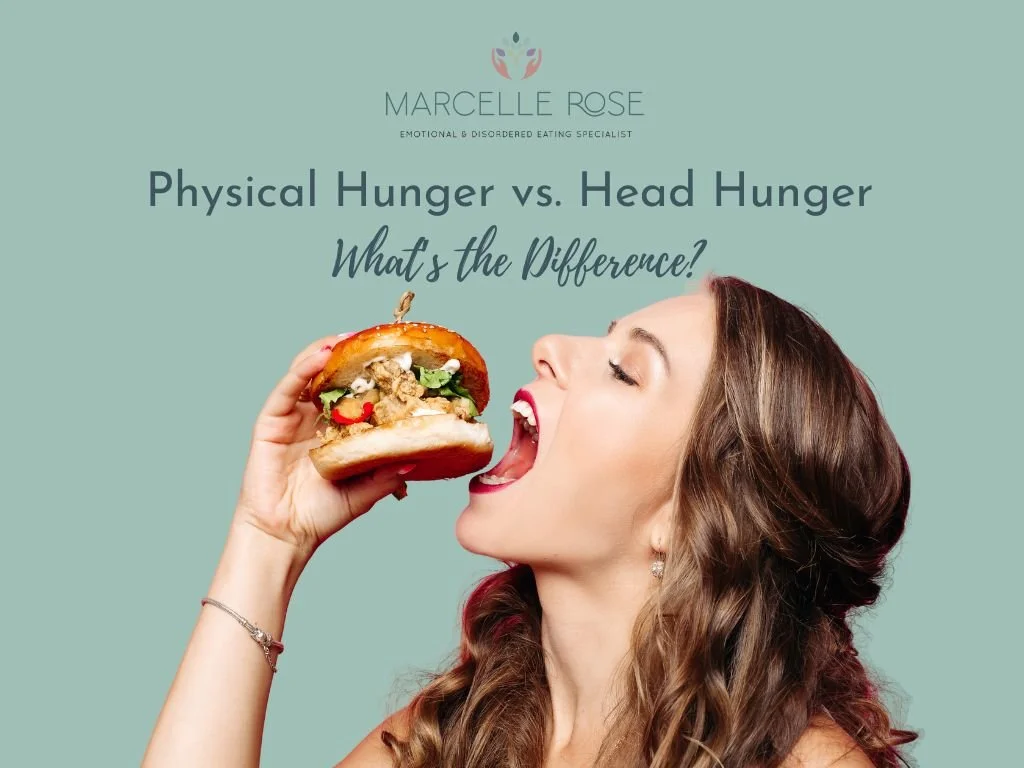
One of the most important first steps in healing your relationship with food is learning to identify whether what you're experiencing is physical hunger or head hunger.
Physical hunger is felt in the body often as a hollow sensation in the stomach, light-headedness, or low energy. It builds gradually and tends to stick around regardless of whether you see or smell food.
Head hunger, on the other hand, is triggered by external cues. Maybe you pass a bakery, smell fresh pastries, and suddenly feel like you have to have one. There’s no stomach signal, just a pull based on habit, emotion, or environment. Maybe it’s stress. Maybe it’s sadness. Maybe it’s simply routine.
Here’s the thing: head hunger isn’t bad. It’s not a sign of weakness. It’s often a sign of an unmet emotional physical or psychological need. Meeting that with self-compassion rather than shame is key to lasting change.
What If You Feel Hungry All the Time?
If you feel constantly hungry, even after eating, that doesn’t mean something is wrong with you. It’s likely to mean you haven’t been giving your body what it needs.
Many of my clients have been following rules about how much they should eat for so long that they’ve lost touch with what ‘enough’ feels like. Unsurprisingly, their body is shouting louder just to get it’s basic needs met.
Only the other day another one of my clients shared how shocked she was at the difference it made when she gave herself permission to eat three balanced meals a day and a mindful snack when needed. The evening binges stopped. She felt satisfied, calmer, and more connected to her body.
And What If You Just… Don’t Know?
We’re all born knowing how to eat. Think of babies and toddlers. They cry when they’re hungry, push food away when they’re full, and don’t overthink it.
But somewhere along the way, thanks to diet culture, social messaging, and restrictive eating, those instincts become suppressed. Have you ever been on a diet that encouraged you to actually listen to your hunger? Probably not.
The good news? This is a skill you can relearn. With curiosity, consistency, and the right support, you can rebuild trust in your body’s signals. I’ve seen clients shift from anxious, rule-bound eating to relaxed, nourishing meals, and the ripple effect on their life is often profound.
Recent neuroimaging studies have shown that mindful eating practices enhance communication between brain regions responsible for internal bodily awareness and emotional regulation, helping you respond to genuine hunger cues, not just environmental triggers.
Adding to this, a ground-breaking 2025 study identified distinct ‘hunger’ and ‘thirst’ neurons in the amygdala in the brain that directly drive eating behaviour based on internal states. This helps explain how emotions influence eating, and why tuning into your body, rather than overriding it, is so powerful for healing food struggles.
You deserve to feel safe with food and confident in your body’s wisdom.
If you’re struggling to make sense of your hunger, This is something I explore in my Breaking the Cycle Starter Kit, which you can currently download for FREE.
I also do a much deeper dive on this and much more, in my best-selling book: The Binge Freedom Method™: Your Four Pillar Plan to Beat Emotional Eating for Good. Inside, you'll discover practical tools to help you overcome emotional eating and binge eating, improve body acceptance, strengthen self-compassion, and create lasting food freedom.