
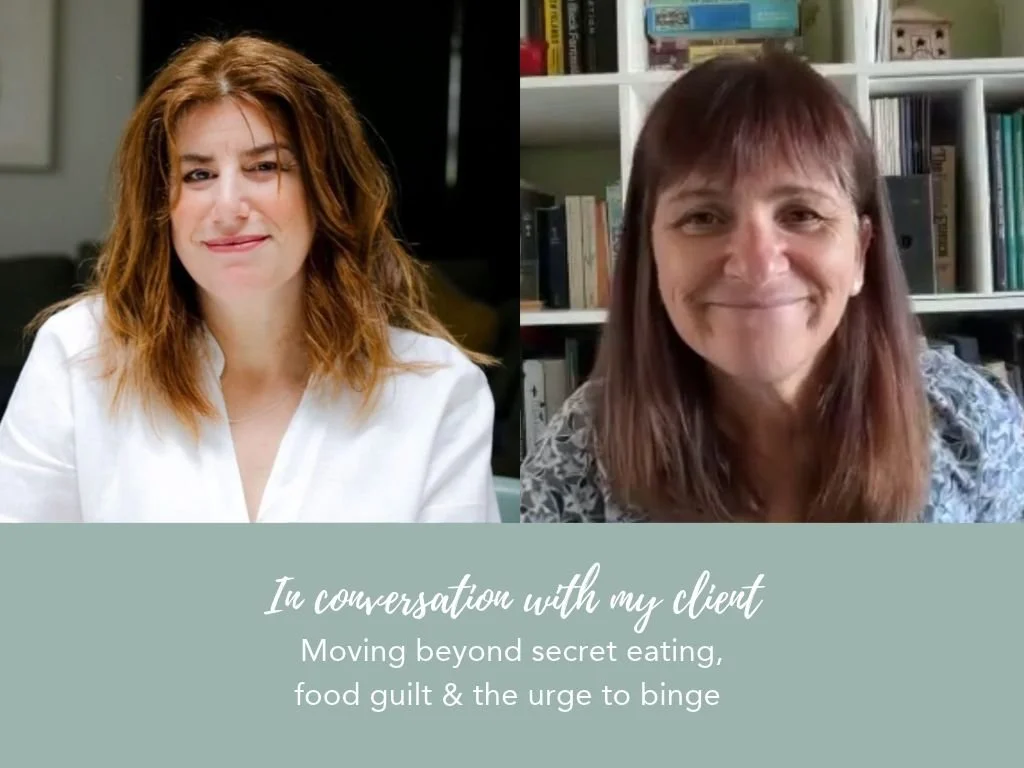
“I am enjoying food more than I ever have in my whole life.”
This was one of the things my client shared when we sat down to reflect on our work together, around 6 months after we began.
Pauline had spent decades struggling with binge eating, restriction and eating in secret. She had always considered herself someone who loved food. But alongside that enjoyment was a insidious stream of thoughts about what she should eat, whether she deserved it and what other people might think.
Understanding the struggle beneath the surface
Before we started working together, my client had already done a great deal of work on her mental wellbeing. She understood body positivity and had even written and performed a show about it.
Yet food remained an area of difficulty.
There was the eating that other people saw, and then there was the eating she did privately. Pauline often felt uncomfortably full, yet still craved chocolate. She worried that people would judge her for eating something sweet in public.
Exercise was also tied to permission to eat: if she had exercised enough, she felt she had “earned” her food.
Some of Pauline’s rules had become so familiar that she barely recognised them as rules.
Eventually it was a conversation with her counsellor that helped Pauline recognise that she wanted to find help to finally address her relationship with food.
Watch the full conversation HERE
What helped Pauline change her relationship with food?
Approaching thoughts with curiosity
When I asked which parts of our work had helped most, Pauline’s answer was clear:
“The idea of I’m just going to notice what my brain is thinking with curiosity, not with judgement, is huge.”
Instead of criticising herself for wanting food, she began asking questions. Was she hungry? Had she slept poorly? Had she been particularly active? Had something happened that affected how she was feeling?
This gave Pauline a way to understand her experience without immediately deciding she had done something wrong.
She also began noticing how much shame had surrounded her eating. Being able to express some of those thoughts aloud helped her question beliefs she had carried for years.
As she put it:
“Losing shame is just a delicious thing.”
Recognising where the urgency around food came from
As the youngest of four children, my client remembered a feeling the need to eat something quickly before somebody else did and that sense of urgency continued into adulthood.
Exploring her food world as a child, helped Pauline recognise the messages around food that were still influencing her eating.
Over time, Pauline’s response began to change. Opening the chocolate drawer and finding it empty no longer brought the same upset or urgency. She knew she could buy more and that if chocolate was available, it didn’t need to be eaten immediately.
Eating regularly and getting to know her appetite
We worked on establishing regular, nourishing meals and helping my client recognise her own appetite signals.
Previously, Pauline had skipped breakfast for years. Later, she began eating a late breakfast, followed by chocolate and then lunch soon afterwards. She often felt overly full during the afternoon and wasn’t hungry for her evening meal.
Now, she eats breakfast earlier and has a more regular meal pattern, with the freedom to have snacks when she wants or needs them.
Pauline described no longer feeling uncomfortably full and now recognises hunger in a way she hadn’t before. There was also a shift towards adding nourishment and variety.
The changes became something Pauline could enjoy, rather than another set of rules to follow.
Moving away from daily weighing and “earning” food
Previously, weighing herself had been part of Pauline’s daily routine. One of the first changes Pauline made was getting rid of her scales.
Without the scales, she began noticing how different it felt to start the morning without a number that she would react to. Over time, Pauline’s weight no longer demanded the same attention.
Her thinking around exercise changed too. Pauline still loves tennis and being active, but her mindset had changed about earing food through movement.
Instead of thinking “I’ve exercised, so I deserve to eat”, she now recognises: “I’ve been active, so my body may need more food.”
What changed beyond my client’s eating?
Some of the most meaningful changes weren’t necessarily visible to others.
Pauline described no longer eating in secret, no longer having urgency around food and having more freedom to choose what she actually fancied. She became more curious about different flavours and more able to enjoy her meals.
Pauline’s body also became less central to her identity.
“It’s about what my body is like isn’t defining who I am in the same way anymore.”
When I asked Pauline what she would say to someone considering getting support, she reflected on how much happier and more content she felt, adding: “That investment in yourself is so worth it.”
For me, Pauline’s story captures some of the most powerful things about building about a peaceful relationship with food.
This is one client’s experience, and everyone’s path will look a little different. But if you recognise yourself in Pauline’s story, remember that however long you’ve been struggling, you don’t have to keep facing this alone.
If you’d like support to move away from binge eating, food rules, body image distress and guilt, book in a complimentary call HERE to explore how we could work together.
If you’d like to get started today, I explore the strategies and tools I share with my clients in my best-selling book: 📕 The Binge Freedom Method™️: Your Four Pillar Plan to Beat Emotional Eating for Good. You can download a free chapter of my book HERE